A long follow-up can look like the last chapter of one continuous experiment. Before reading it that way, draw the doorway into each phase. Who was invited, who qualified, who agreed, and who still supplied information? Those are scientific questions because every doorway can change the people represented by the final result. A count of participants tells us where observation began; a completion percentage describes a later event with its own denominator.
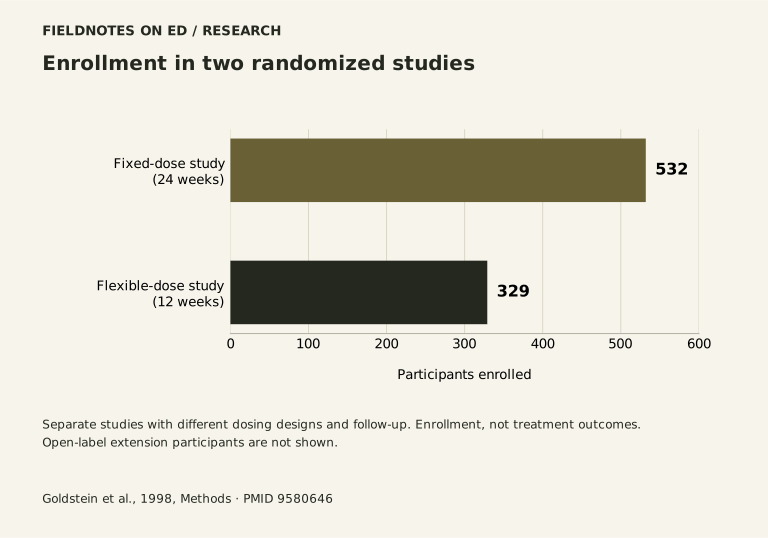
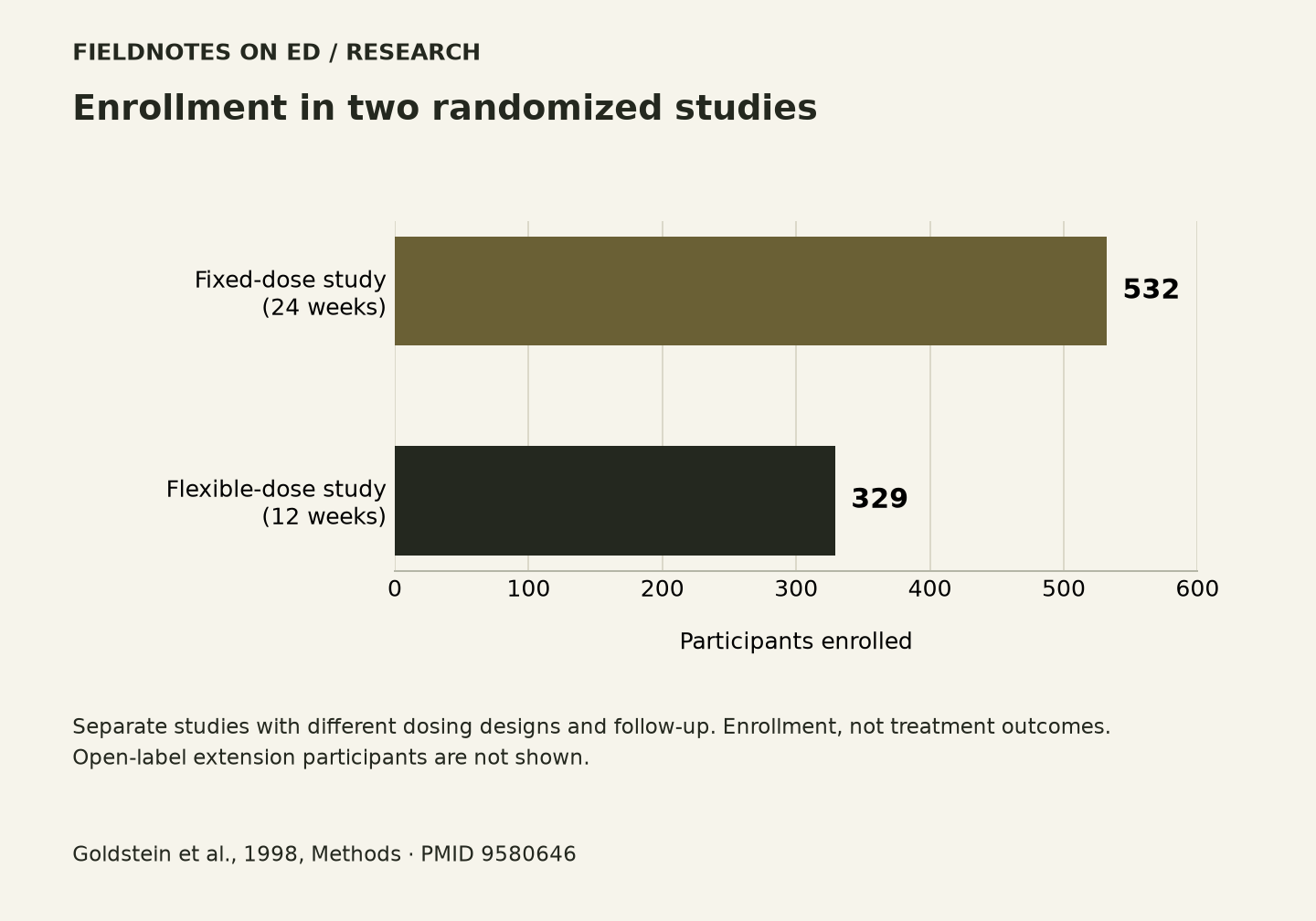
Goldstein reported two randomized oral sildenafil-versus-placebo studies; the flexible-dose extension admitted completers without serious adverse effects. That compact design fact is the starting point for this notebook. The sections below develop original methodological reasoning, rather than reconstructing unreported participant histories. All numerical examples are invented teaching examples. Their purpose is to make the meaning of selection visible before attaching a conclusion to a published number.
Trial chart and data
Download chart (PNG) · Download data (CSV) · Download vector (SVG)
| Randomized study | Reported value |
|---|---|
| Fixed-dose study (24 weeks) | 532 |
| Flexible-dose study (12 weeks) | 329 |
Separate studies with different dosing designs and follow-up.
Enrollment, not treatment outcomes. Open-label extension participants are not shown.
Draw the study boundary before reading the bars
Begin a research note with a box for each separate experiment. Inside each box, write the treatment comparison, observation window and definition of the outcome. Only then put participant counts beside it. This ordering prevents a surprisingly easy mistake: treating every number on a page as part of the same calculation. Two columns can depict distinct populations even when their color, axis and medicine name match. Visual proximity does not create a common comparison group.
An enrollment count can help judge the scale of a research effort, but it supplies neither a numerator of improvement nor a measurement of change. Dividing one enrollment bar by another would produce a ratio of study sizes. It would not estimate a treatment effect. Pooling observations would require a defensible shared question, compatible outcome definitions and an analysis that preserves differences between studies. Simply adding the bars would conceal those decisions. A useful margin note is therefore a sentence specifying what each bar counts and which claim would require a different dataset. This is an interpretation rule, not an additional finding from the paper.
Random assignment protects a comparison at its starting line
Random assignment makes treatment allocation independent of a participant’s initial prospects in the assignment process. In an adequately conducted experiment, that gives investigators a basis for attributing differences between assigned groups to the intervention, subject to uncertainty and the rest of the study design. It does not promise identical people in every group. Chance imbalance remains possible, and a small sample can display substantial differences in measured characteristics even when allocation was conducted properly.
Now imagine sorting participants again after treatment begins, keeping only those who complete visits or wish to continue. The new sorting rule can depend on experiences that treatment itself helped create. A comparison among the remaining participants therefore needs fresh justification; the original allocation cannot automatically protect every later subset. This is a causal question about how a group was formed, not an accusation that any individual chose incorrectly. It also helps distinguish research eligibility from clinical assessment. Our assessment fieldnote provides a separate place to prepare health questions; matching a few trial characteristics would not settle personal suitability.
An extension has several denominators
For an extension, sketch a sequence: potentially eligible, actually eligible, invited, enrolled, and observed at the relevant visit. A report may combine some steps or omit a count. Keep the unknown step marked as unknown. Filling the gap with the nearest available number silently changes the question. In particular, a proportion calculated among people who chose additional follow-up is conditional on having reached that stage. Conditional means that the statement applies after specified conditions have already been met.
Consider a wholly hypothetical sequence. Of 80 eligible people, 60 enter follow-up and 54 finish it. Completion among entrants is 54 divided by 60, or 90%. Completion relative to the eligible group is 54 divided by 80, or 67.5%. Both calculations are arithmetically correct; their wording must identify their different starting populations. Neither calculation reveals how many benefited. Nor can either tell us why the remaining people did not enter or finish. The example illustrates a denominator choice, not any numbers or results from the sildenafil research.
| Stage or calculation | Invented value | Question answered |
|---|---|---|
| Eligible | 80 people | Who could enter this phase? |
| Enrolled | 60 people | Who actually entered? |
| Completed | 54 people | Who reached its endpoint? |
| Completed / enrolled | 90% | What fraction of entrants finished? |
| Completed / eligible | 67.5% | What fraction of eligible people finished? |
Retention is an outcome about remaining
A person can remain in follow-up while reporting little benefit, or leave despite reporting benefit. To understand retention, keep at least three variables apart: whether treatment continued, whether research visits continued, and whether a defined health outcome occurred. They may be related, but no one of them logically supplies the others. An analysis that treats completion as success has changed the meaning of success unless completion itself was the question being studied.
A useful hypothetical exercise is to imagine two extensions with the same retention percentage. In one, participants remain because the treatment helps and visits are manageable. In another, participants remain to discuss disappointing results or because investigators make follow-up easy. Identical retention can coexist with different clinical experiences. Conversely, moving away or losing contact could reduce retention without establishing a medicine problem. These examples identify information worth requesting: reasons for leaving, whether outcome collection continued after treatment stopped, and how visits were organized. They do not supply explanations for the departures in this paper. Reasons recorded by a study also deserve their exact wording rather than being collapsed into a single favorable or unfavorable category.
Selection after an adverse experience changes the question
Imagine that an extension invites only people who have passed an earlier tolerability screen. The follow-up would then describe an already filtered population. That could be an appropriate design for learning about continued use among those people. It would answer a narrower question than the experience of everyone starting treatment for the first time. To judge applicability, write the full population description alongside the estimate instead of dropping the entry condition from the sentence.
The missing group matters because its absence may be connected to the very event under investigation. If a hypothetical earlier phase removes people after a particular reaction, the later phase has fewer people known to have had that reaction. A low later frequency cannot then be read as if no filtering occurred. This reasoning does not prove the size or direction of any overall bias; it shows why the entry rule belongs in the interpretation. When preparing a clinical conversation, the blood-pressure fieldnote can help organize questions about the health information a prescriber needs. An extension’s eligibility rule is not a substitute for that review.
People and time belong on separate lines
Counting people measures the size of a cohort. Counting observation time measures how much time was available to record an event. Neither can replace the other without changing the units. This becomes important when participants enter at different times or leave before the end. A statement that a study lasted several months does not mean every participant contributed that full interval. The record needs both the study calendar and the amount of information actually available.
In another invented example, 20 people observed for six months contribute 120 person-months. Forty people observed for three months also contribute 120 person-months. Equal totals do not make the designs equivalent: the latter has more starters, while the former observes each person longer. If an event’s frequency depends on time since starting, those patterns could yield different information. Calculating an event rate would additionally require the event count, the definition of time at risk and a rule for repeat events. No event rate is calculated here. The point is to notice which denominator a proposed interpretation requires before doing arithmetic with the numbers that happen to be visible.
| Quantity | Required record | Interpretive boundary |
|---|---|---|
| Participants | Distinct people counted once | Does not supply their observation time |
| Completed visits | People reaching a defined visit | Does not classify clinical benefit |
| Person-time | Each person’s eligible observation interval | Does not describe the shape of individual follow-up |
| Events | An explicit event definition and count | Does not identify a rate without time or people at risk |
Missing information is a question about the unseen record
A missing outcome has no direction until an analysis assigns it one or makes an assumption about it. Treating every absent report as failure is an assumption. Treating every absent report as unchanged is another. Analyzing only available observations also makes an implicit demand: the remaining observations must adequately answer the intended question. That demand becomes harder to defend if absence depends on an outcome that is itself unobserved.
To reason about sensitivity, imagine an estimate recalculated under several plausible accounts of the missing records. Would the substantive interpretation remain similar if those records were somewhat less favorable? How much difference would be needed to change the conclusion? These are questions an analyst could investigate, not claims that this paper performed those analyses. The companion notebook on daily tadalafil develops the separate problem of using an earlier measurement in place of a later one. The distinction is useful: selecting who remains in a cohort and choosing a value for a missing measurement are different operations. A careful ledger marks both rather than using a broad phrase such as complete follow-up to cover them.
Precision cannot repair a poorly matched question
Suppose an estimate is numerically precise within a selected group. That precision concerns random uncertainty for the specified analysis; it does not erase the selection that defined the group. A narrow confidence interval and broad applicability are separate properties. Conversely, an imprecise estimate may address the right population but leave too much statistical uncertainty for a firm conclusion. Reading research requires keeping the target question and the estimate’s precision on separate lines.
A strong follow-up question therefore asks more than whether the reported result is statistically persuasive. It asks whether the comparator, observation period and included people answer the intended decision. To compare an extension with a newly starting population, one would need information about the entry filters and the people excluded by them, plus justified assumptions about transfer. Disclosure information also belongs in the notebook: financial and analytic roles can guide questions about planning and transparency without measuring bias by themselves. For a personal follow-up, organizing the response record is a practical way to preserve observations without pretending that one person’s account is a controlled experiment.
Current safety instructions require their own record
The current Viagra label lists headache, flushing and indigestion among adverse reactions. Nitrates or nitrites and guanylate cyclase stimulators such as riociguat are contraindicated. Alpha-blockers, antihypertensives, cardiovascular health, other medicines and kidney or liver conditions require clinical review. Do not combine PDE5 inhibitors or other ED treatments independently. An erection lasting more than four hours needs immediate help. Stop the medicine and seek prompt care for sudden vision loss or sudden hearing decrease or loss. Stop sexual activity and obtain immediate medical help for chest pain, dizziness or nausea during sex.
Keep those action instructions separate from routine observation notes. An urgent symptom should not become a data point saved for an ordinary follow-up visit. For nonurgent review, a useful record identifies what was taken, when it was taken, the observed experience and what remains uncertain. Use the medicine-identity guide to make the prescription description specific. The methodological lesson here is about the purpose of a document: a historical research report evaluates a defined experiment, while current prescribing information supplies product warnings and counseling. Neither document allows a reader to construct an individual regimen from enrollment or completion figures.
Carry the question into a service comparison
An evidence trail should end with a clear description of the proposed product and the care arrangement. As an editorial interpretation, checking documentary details is useful because those details establish what question remains unanswered. The Ro profile and Hims profile are places to examine published terms, not sources of trial outcomes. A named ingredient in an offer cannot establish that the service, preparation or experience has been tested in the experiment discussed here.
FDA does not approve compounded drugs or evaluate their safety, effectiveness and quality before marketing; these preparations can nevertheless serve legitimate medical needs. Ask for the actual ingredients, strength, dosage form, route and dispensing pharmacy before attaching evidence to a product. Then keep a separate note on access to a prescriber and the route for an unresolved concern. This is a reasoning aid for documentary comparison, not a provider ranking. A complete record can reveal that an appealing headline and a research estimate refer to different questions. Recognizing that mismatch is useful even when no calculation can resolve it.
Questions about the evidence
Does a high completion percentage show that most people benefited?
It shows completion under the stated definition and denominator. Benefit requires its own outcome measurement. To connect the two, a report would need to describe clinical results among the relevant people and how missing results were handled. An appealing retention number cannot supply those observations by itself.
Why keep separate studies separate if they examine the same medicine?
A shared ingredient does not create a shared experiment. Populations, assignment rules, observation periods and measurements can differ. Combining evidence may be useful when those differences are handled explicitly, but adding enrollment counts creates no treatment comparison and no common clinical endpoint.
Is selection into follow-up automatically a flaw?
No. A selected group can answer a useful question about the people who qualify for that phase. The interpretive problem appears when the result is described as if the entry conditions did not exist. State the population precisely before deciding whether it matches the intended question.
Can missing participants simply be counted as having no benefit?
That is one possible assumption, not an observed fact. Its appropriateness depends on the question and the reasons information is absent. A useful sensitivity analysis would examine whether a conclusion changes under credible alternatives, while keeping measured outcomes distinguishable from assumed values.
What should I write down after reading an extension report?
Record the entry conditions, the denominator for each result, the observation window and the actual outcome definition. Add the handling of missing information and the question the result leaves open. This compact ledger makes it easier to notice when a later claim extends beyond the people or experience represented.
Editorial assessment
The most useful fieldnote follows the people before interpreting the percentage. Random assignment, entry into another phase, continued treatment and completed observations each describe a different step. Keeping those steps visible lets a reader value additional follow-up while stating its population accurately. A well-kept ledger ends with an answerable research question, rather than a promise about an individual or a service.
Research access and limitations
The complete original article was reviewed through a public USPTO exhibit; no protocol or participant-level data were reviewed. Hypothetical examples explain methods and do not reconstruct unpublished outcomes.
Trace the information
Scientific sources carry their own access dates below. Existing medical and provider records retain their original October 6 or 7 checks. Provider pages establish advertised claims. Medical sources supply general context; citation does not imply endorsement.
- Goldstein et al. (1998): oral sildenafil trialFull primary paper via public exhibit · Checked 2026-10-23Full primary paper (PDF)
- Porst et al. (2006): daily tadalafil trialFull primary paper via public exhibit · Checked 2026-10-23Full primary paper (PDF)
- VIAGRA (sildenafil citrate) US prescribing informationOfficial prescribing information; relevant sections reviewed · Checked 2026-10-23
- Understanding the risks of compounded drugsFDA public guidance · Checked 2026-10-23